
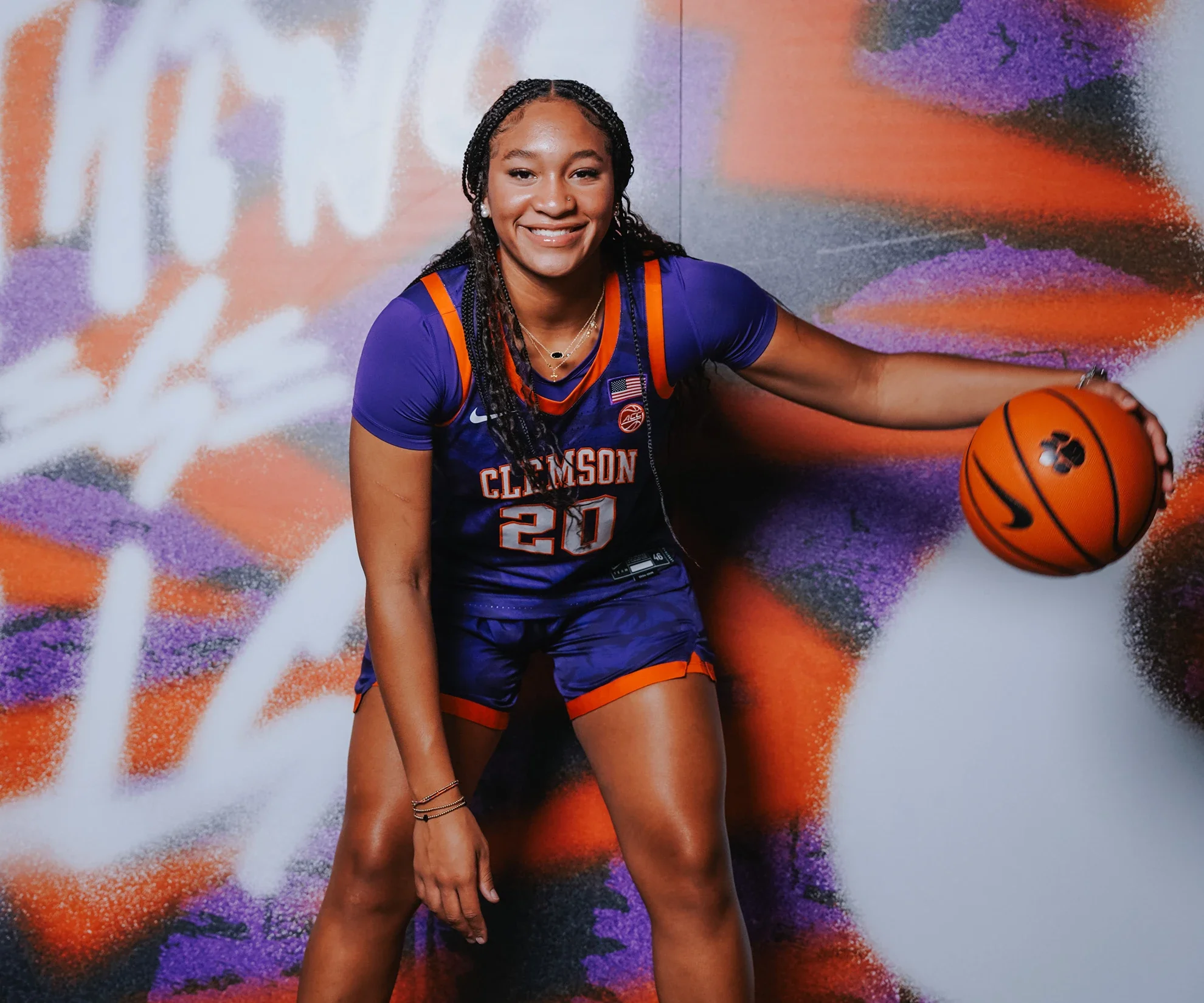
Photo: Clemson Athletics
The Tigers improve to 5-1 behind career-best scoring performances, relentless defensive pressure and a season-high 22 assists at Littlejohn Coliseum.
By Dez B, Pretty Girls Media
Nov. 25, 2026
CLEMSON, S.C. — Clemson women's basketball continued its strong start to the 2026-27 season Wednesday night, defeating USC Upstate 84-43 at Littlejohn Coliseum behind career-high scoring performances from freshman forward Kimora Fields and sophomore guard Taliyah Henderson.
The Tigers improved to 5-1, while the Spartans fell to 4-2.
Fields led Clemson with a career-high 18 points, Henderson added a career-best 16 points and Mia Moore contributed 15. Senior guard Rusne Augustinaite finished with a season-high 11 points, giving the Tigers four players in double figures.
Clemson never trailed, combining efficient perimeter shooting, unselfish offensive execution and disruptive defense to secure a commanding 41-point victory.
The performance also extended Clemson's recent success at Littlejohn Coliseum, where the Tigers have won 17 of their past 19 games.
Kimora Fields delivers a breakout performance
Fields recorded the first double-digit scoring performance of her collegiate career, finishing with a team-high 18 points.
The freshman forward was particularly effective in the fourth quarter, scoring eight points while converting all four of her field-goal attempts.
Her ability to remain productive late in the contest helped Clemson maintain its offensive momentum and close out the victory.
Fields' emergence provides Clemson with another scoring option as the Tigers continue developing their offensive identity early in the season.
For a freshman adjusting to the collegiate level, a career-best performance represents an encouraging development. The next challenge will be establishing consistency against increasingly competitive opponents.
Kimora Fields by the numbers
Points: 18.
Fourth-quarter points: Eight.
Fourth-quarter field goals: 4-of-4.
Fourth-quarter field-goal percentage: 100%.
Career-high scoring performance.
First collegiate double-digit scoring game.
Clemson's leading scorer against USC Upstate.
Taliyah Henderson sets the tone with a dominant first half
While Fields led Clemson in total scoring, Henderson established the offensive tone during the first two quarters.
The sophomore guard scored all 16 of her points before halftime, individually outscoring USC Upstate's entire team, which managed just 15 first-half points.
Henderson also connected on a career-high four 3-pointers, contributing significantly to Clemson's perimeter shooting success.
Her performance marked her second consecutive double-digit scoring game and fourth of the season.
Henderson's ability to stretch the defense helped Clemson establish separation early, forcing USC Upstate to account for multiple scoring threats along the perimeter.
Her continued development as an outside scoring option could become increasingly valuable as the Tigers approach conference competition.
Taliyah Henderson by the numbers
Points: 16.
First-half points: 16.
First-half USC Upstate points: 15.
3-pointers made: Four.
Points scored from beyond the arc: 12.
Consecutive double-digit scoring games: Two.
Double-digit scoring games this season: Four.
Career highs in points and 3-pointers made.
Clemson's supporting cast delivers balanced production
Fields and Henderson were not the only Tigers to make significant contributions.
Moore finished with 15 points and four assists, recording her fourth double-digit scoring performance of the season.
Augustinaite added a season-high 11 points, connecting on three of four attempts from beyond the arc.
The senior guard's 75% 3-point shooting provided another efficient scoring option and contributed to Clemson's ability to maintain offensive spacing.
Mackenzie Nelson led the Tigers with five assists, while Moore and Meeyah Green each recorded four.
The trio combined for 13 of Clemson's season-high 22 assists, accounting for approximately 59% of the team's total.
That distribution highlights Clemson's ability to generate offense through multiple playmakers rather than relying on one primary ball handler.
Clemson's standout contributors
Kimora Fields: 18 points.
Taliyah Henderson: 16 points and four 3-pointers.
Mia Moore: 15 points and four assists.
Rusne Augustinaite: 11 points and 3-of-4 shooting from beyond the arc.
Mackenzie Nelson: Five assists.
Meeyah Green: Four assists.
Fields, Henderson, Moore and Augustinaite combined for 60 of Clemson's 84 points, accounting for approximately 71.4% of the team's scoring production.
How the game was decided
Clemson established control early and never surrendered the lead.
The Tigers' combination of perimeter shooting and defensive pressure created a significant first-half advantage that USC Upstate was unable to overcome.
Clemson connected on nine 3-pointers during the first half, shooting approximately 64% from beyond the arc.
USC Upstate struggled to establish offensive rhythm, shooting 29% from the field and failing to convert a 3-point attempt before halftime.
The second quarter proved particularly decisive.
Clemson held the Spartans to just five points during the period, while Henderson's first-half scoring performance helped the Tigers build a 41-15 halftime advantage.
The 26-point halftime lead placed USC Upstate in a difficult position, requiring the Spartans to overcome both a substantial scoring deficit and Clemson's defensive pressure.
Rather than allowing USC Upstate to generate a significant comeback, Clemson outscored the Spartans 43-28 during the second half.
Fields' efficient fourth-quarter performance helped the Tigers finish with an 84-43 victory.
Scoring breakdown
First-half score: Clemson 41, USC Upstate 15.
Clemson's halftime lead: 26 points.
Second-half scoring: Clemson 43, USC Upstate 28.
Second-half scoring advantage: Clemson by 15.
Final score: Clemson 84, USC Upstate 43.
Final margin of victory: 41 points.
USC Upstate second-quarter points: Five.
Lead changes: Zero.
Clemson's defense continues to establish its identity
Although Clemson's offensive production generated several individual milestones, its defensive performance was equally significant.
The Tigers recorded 13 steals and forced 22 turnovers, limiting USC Upstate's opportunities to establish sustained offensive possessions.
Clemson scored at least 30 points off turnovers for the second consecutive game, demonstrating its ability to convert defensive disruption into offensive production.
The Spartans became the fifth opponent in six games that Clemson has held below 60 points this season.
Holding USC Upstate to 43 points also demonstrated the Tigers' ability to maintain defensive control throughout the contest.
Clemson's five-point defensive second quarter marked the seventh time in program history that the Tigers have held an opponent to five points in the second period, according to the team's postgame report.
The ability to generate steals and force turnovers provides Clemson with opportunities to create transition offense before opposing defenses can become organized.
That connection between defensive pressure and offensive efficiency was one of the defining elements of Wednesday's victory.
Clemson's defensive numbers
Points allowed: 43.
First-half points allowed: 15.
Second-quarter points allowed: Five.
Steals: 13.
Turnovers forced: 22.
Points off turnovers: At least 30.
Consecutive games scoring at least 30 points off turnovers: Two.
Opponents held below 60 points this season: Five of six.
Ball movement fuels Clemson's offensive efficiency
Clemson recorded a season-high 22 assists, highlighting the team's ability to share the basketball and create scoring opportunities.
Nelson's five assists led the way, while Moore and Green each contributed four.
The Tigers' passing production complemented their perimeter shooting, particularly during a first half in which Clemson converted nine 3-pointers.
Effective ball movement can force defensive rotations, create open perimeter opportunities and prevent opposing defenses from concentrating on one scoring threat.
With four players finishing in double figures, Clemson demonstrated the benefits of distributing offensive responsibilities throughout its lineup.
The Tigers also used the same starting five for the sixth consecutive game, providing continuity as the team continues building chemistry early in the season.
Maintaining that offensive connectivity will become increasingly important against opponents capable of applying greater defensive pressure.
USC Upstate struggles to establish offensive rhythm
USC Upstate entered the matchup with a 4-1 record but struggled against Clemson's defensive intensity.
Junior guards Grace Booth and Izzy Callaway shared the team scoring lead with nine points each.
Together, Booth and Callaway accounted for 18 of the Spartans' 43 points, approximately 41.9% of the team's scoring output.
USC Upstate's first-half shooting struggles, combined with its 22 turnovers, made it difficult to keep pace with Clemson.
The Spartans improved their scoring production after halftime, recording 28 second-half points compared with 15 in the first half.
However, Clemson's continued offensive production prevented USC Upstate from significantly reducing the deficit.
USC Upstate's standout contributors
Grace Booth: Nine points.
Izzy Callaway: Nine points.
Combined scoring from Booth and Callaway: 18 points.
First-half team points: 15.
Second-half team points: 28.
First-half field-goal percentage: 29%.
First-half 3-point percentage: 0%.
Total turnovers: 22.
By the numbers: Clemson vs. USC Upstate
Final score: Clemson 84, USC Upstate 43.
Updated records: Clemson 5-1, USC Upstate 4-2.
First-half points: Clemson 41, USC Upstate 15.
Second-half points: Clemson 43, USC Upstate 28.
First-half 3-point percentage: Clemson approximately 64%, USC Upstate 0%.
Clemson first-half 3-pointers made: Nine.
Clemson total 3-pointers made: At least 10.
Clemson assists: 22.
Clemson steals: 13.
USC Upstate turnovers: 22.
Clemson points off turnovers: At least 30.
Clemson players scoring in double figures: Four.
USC Upstate leading scorers: Grace Booth and Izzy Callaway, nine points each.
Clemson leading scorer: Kimora Fields, 18 points.
Margin of victory: 41 points.
Clemson's all-time record against USC Upstate: 4-0.
Clemson's record over its past 19 home games: 17-2.
What went right for Clemson
Defensive pressure created offensive opportunities
Clemson's ability to force 22 turnovers and generate 13 steals was central to its success.
Scoring at least 30 points off turnovers for the second consecutive game illustrates how the Tigers are using defensive disruption to create additional scoring opportunities.
Perimeter shooting established early separation
Nine first-half 3-pointers helped Clemson build a substantial lead before halftime.
Henderson and Augustinaite provided efficient outside scoring, demonstrating the value of having multiple perimeter threats capable of stretching opposing defenses.
Multiple players contributed offensively
Four double-digit scorers allowed Clemson to distribute its offensive responsibilities.
Fields' career-high performance and Henderson's first-half production were complemented by Moore and Augustinaite, preventing the offense from becoming dependent on one player.
Offensive chemistry continues to develop
A season-high 22 assists demonstrated Clemson's ability to create scoring opportunities through ball movement.
The continued use of the same starting lineup also provides opportunities for players to develop familiarity with one another's tendencies and offensive responsibilities.
What Clemson can improve moving forward
Despite the convincing victory, Clemson will face more demanding tests as the season progresses.
Maintain offensive efficiency when outside shots are not falling
Clemson's first-half perimeter shooting was a major advantage against USC Upstate.
Against opponents capable of limiting open 3-point opportunities, the Tigers will need to maintain offensive balance through interior scoring, penetration and effective half-court execution.
Continue developing younger contributors
Fields and Henderson demonstrated their scoring potential, but maintaining consistent production across multiple games will be important.
Their continued development could provide Clemson with additional offensive depth throughout the season.
Sustain defensive execution against stronger opponents
Clemson's defensive pressure has been effective during its opening six games.
As the Tigers encounter opponents with more experienced ball handlers and greater offensive depth, maintaining disciplined rotations, communication and defensive positioning will become increasingly important.
Build on lineup continuity while developing depth
Using the same starting five through six games has provided Clemson with early-season stability.
Developing dependable contributions throughout the rotation could help the Tigers manage fatigue, foul trouble and the demands of conference competition.
These areas represent forward-looking priorities rather than specific deficiencies established by Wednesday's result.
What the victory means for Clemson
With a 5-1 record, Clemson continues to build momentum during its nonconference schedule.
The Tigers have demonstrated an ability to control games through defensive pressure while receiving scoring contributions from experienced players and emerging younger talent.
Their recent success at Littlejohn Coliseum also remains notable.
Clemson has won 17 of its past 19 home games, producing an approximately 89.5% winning percentage during that stretch.
The victory also extended Clemson's undefeated record against USC Upstate to 4-0.
While nonconference success does not guarantee similar results against Atlantic Coast Conference opponents, performances such as Wednesday's provide opportunities to develop chemistry, evaluate rotations and establish consistent team standards.
Fields' emergence, Henderson's continued scoring production and Clemson's defensive consistency are encouraging developments as the Tigers prepare for the remainder of the season.
Source: Clemson women's basketball postgame report, Nov. 25, 2026. Additional percentages and scoring comparisons were calculated from the reported statistics.