
UCLA Clips Gamecocks Wings to Win First NCAA Women’s Title
Forty-eight years in the making. Fifteen seasons of building. And one Sunday afternoon in Phoenix that changed UCLA women's basketball history forever.
Mortgage Matchup Center • Phoenix, Arizona • April 5, 2026 • NCAA Women's Basketball National Championship
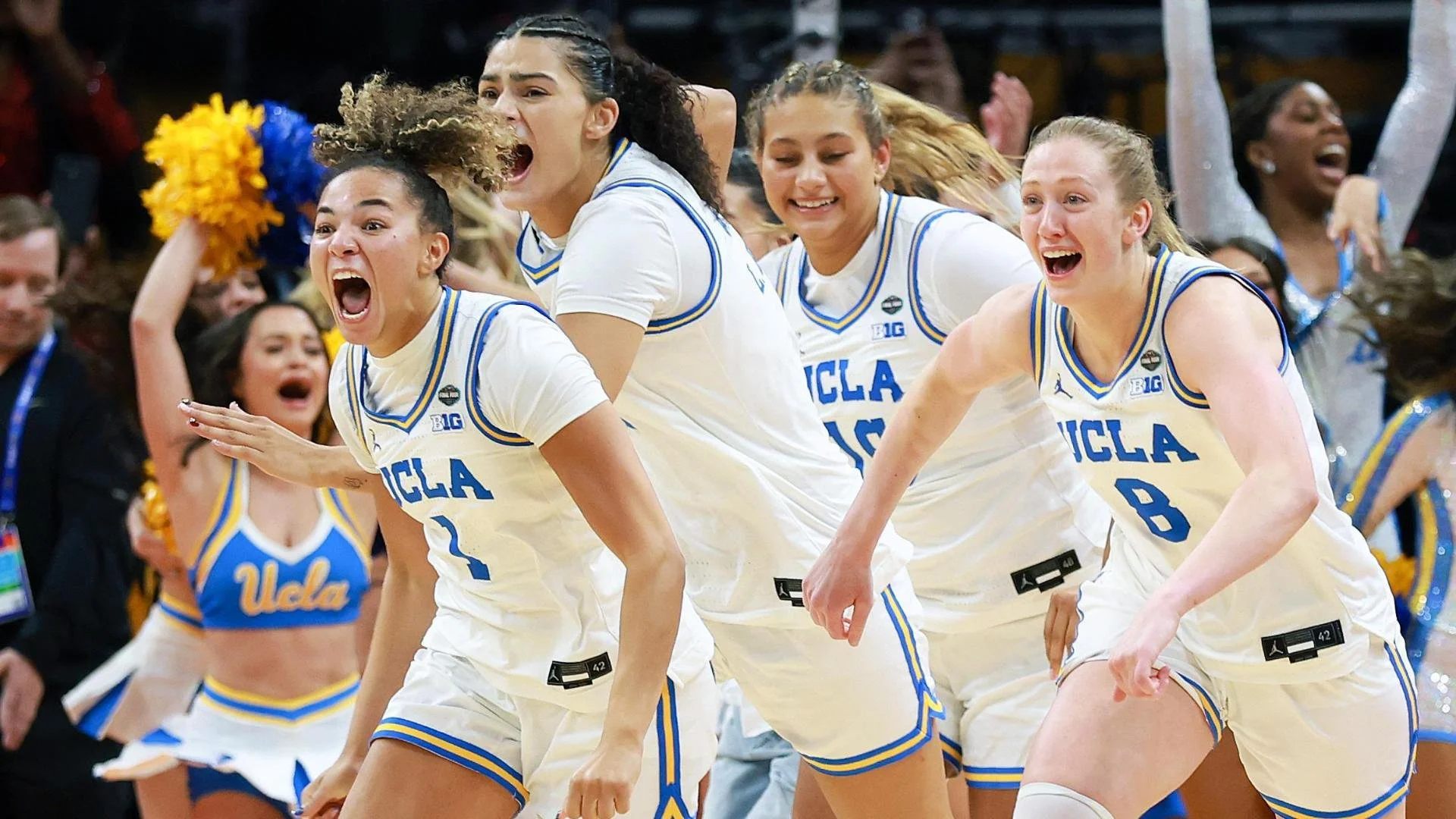
UCLA WNS NCAA NATIONAL CHAMPIONSHIP 2026
PHOENIX, Ariz. — They had never been here before. Not in the NCAA era. Not with the lights this bright, the stakes this high, or the history this close. South Carolina had been to five national championship games since 2017. UCLA had been to none.
It did not show.
The UCLA Bruins defeated the South Carolina Gamecocks 79-51 Sunday afternoon at the Mortgage Matchup Center in Phoenix to win the program's first NCAA women's basketball national championship — delivering Cori Close the title she has been building toward across 15 seasons on the Westwood sideline in the most dominant championship game performance since the sport began crowning NCAA champions in 1982. The 28-point margin of victory stands as the third-largest in women's title game history.
Gabriela Jaquez — playing in front of her brother, Miami Heat forward Jaime Jaquez Jr., who flew to Phoenix after scoring 32 points for the Heat the night before — finished with 21 points, 10 rebounds, and five assists. She became just the fifth player in history to record a 20-point, 10-rebound, five-assist line in a national championship game — and celebrated her final three-pointer of the evening with a roar that captured everything this moment meant to a senior class that has given everything to this program.
Lauren Betts was named the NCAA Tournament's Most Outstanding Player — 14 points, 11 rebounds, dominant interior defense — a 6-foot-7 presence that South Carolina had no answer for from the opening possession to the moment she left the floor to a thunderous ovation with 3:45 remaining, embracing Cori Close in a hug that said everything words could not.
All five UCLA starters finished in double figures. South Carolina managed one.
THE STORY: 15 YEARS, ONE VISION, AND A PYRAMID OF SUCCESS
To understand what Sunday meant, you have to understand who Cori Close is and where this program has come from under her watch.
Close has been UCLA's head coach since 2011-12 — 15 seasons of building, recruiting, developing, and competing without the ultimate prize. She won the WNIT in 2014-15. She built a consistent NCAA Tournament program. She made the Final Four for the first time last season before falling to UConn in a blowout. She came to Phoenix in 2026 as the head coach of a 37-1 team riding a 31-game winning streak — and she closed the season with the championship that 15 seasons of work had been pointing toward.
Close's connection to the program runs deeper than coaching. She was mentored by the legendary John Wooden — the man who won 10 national championships coaching UCLA's men — at age 22, when Wooden was 83. She visited him bi-weekly. She adopted his "Pyramid of Success" philosophy of character-based leadership and built her entire program culture around it. When the final buzzer sounded on Sunday afternoon and the confetti fell on the Mortgage Matchup Center floor, Close — tears flowing, trophy in hand — told ESPN it was "immeasurably more than I could ask or imagine. It's beyond my wildest dreams."
John Wooden's spirit was present at that trophy ceremony whether anyone said his name or not.
THE STAKES: TWO PROGRAMS, TWO VERY DIFFERENT ROADS TO PHOENIX
UCLA entered the championship game at 37-1 — the only loss a November defeat to Texas in a Thanksgiving tournament — riding the momentum of 31 consecutive wins and a semifinal victory over Texas that required a clutch Lauren Betts block on Madison Booker in the game's final seconds to preserve a three-point margin. The Bruins were making their first NCAA title game appearance in program history. First. Ever.
South Carolina entered at 36-3 — three-time national champions, Dawn Staley in her 18th season at the helm, and fresh off one of the most celebrated wins in program history — the Friday Final Four victory that ended UConn's 54-game winning streak and avenged the 82-59 championship game loss from 2025. The Gamecocks were appearing in their fifth national championship game since 2017. They were the most experienced team in the building. They had been here before — multiple times — and they knew exactly what it took to win.
What they did not have on Sunday was their legs, their shooting touch, or an answer for a UCLA team that was faster, longer, more physically dominant, and more locked in than any opponent the Gamecocks had faced in recent championship game memory.
THE FIRST QUARTER: UCLA SERVES NOTICE IMMEDIATELY
The game began the way UCLA's entire 2026 season had been built — with aggression, purpose, and a defensive identity that imposed itself from the opening possession.
Lauren Betts hit the first basket of the national championship game. Charlisse Leger-Walker followed. The Bruins were shooting efficiently from the start while South Carolina — which had gone 1-of-9 from the field in the game's opening minutes — was struggling to find any offensive rhythm at all against a UCLA defense that was physical, positioned, and relentlessly contesting every look.
South Carolina did not go quietly in the early going. The Gamecocks went on a quick 6-0 run to cut the early UCLA advantage to a single possession — showing the grit and championship experience that has defined this program under Staley. But UCLA answered every South Carolina response. Kiki Rice put the finishing touches on an 8-0 Bruins run that closed the first quarter, draining a fallaway jumper from deep that made it 21-10 after ten minutes of play.
Twenty-one to ten. After one quarter. Against a team that had been to five national championship games.
The Gamecocks were shooting 24% from the field. They had missed multiple shots at the rim. The team that had dismantled UConn in the Final Four looked, as one observer noted, "like a different team entirely."
THE SECOND QUARTER: THE GAMECOCKS CANNOT FIND THEIR RHYTHM
Down 15 with six minutes remaining in the first half, South Carolina needed a run. What it got instead was more of the same — an UCLA defense that contested every possession, a rebounding battle that was tilting decisively toward the Bruins, and a shooting performance from the Gamecocks that had no resemblance to the team that had been one of the most efficient offenses in the country all season.
Tessa Johnson was South Carolina's only reliable offensive weapon from the starting lineup — competing hard, finding shots, and refusing to let the margin grow without a fight. But one player against five elite Bruins starters — Betts, Jaquez, Rice, Angela Dugalic, and Charlisse Leger-Walker all contributing efficiently — is not a formula that produces a championship game comeback.
Joyce Edwards — South Carolina's season-long leader in scoring and the player Dawn Staley had built her offensive attack around — was held to just eight points on 3-of-10 shooting. Her interior presence, which had been so dominant against UConn on Friday night, was being neutralized by Betts's defensive positioning and UCLA's team-wide commitment to contesting everything inside. Edwards finished with 11 rebounds but just eight points — a performance that reflected how thoroughly the Bruins had prepared to take away South Carolina's most dangerous scoring option.
UCLA took a 36-23 lead into the locker room. The Gamecocks were shooting 26% from the field at halftime — a number that, as their coaching staff undoubtedly knew, had never produced a national championship in the history of the sport.
THE THIRD QUARTER: UCLA PUTS THE GAME AWAY
If there was a moment when the national championship was decided — when the result moved from possible to inevitable — it was the third quarter.
UCLA outscored South Carolina 25-9 in the third period. Twenty-five to nine. The Bruins nearly doubled the Gamecocks' point total in a single quarter against a team with four national championships in its recent history. The Bruins went on a 13-0 run that was halted only by Joyce Edwards drawing a foul and converting two free throws — the solitary interruption in a stretch of dominance that pushed the score to 61-32 by the time the third quarter buzzer sounded.
Gabriela Jaquez was having the finest individual performance of her college career. Her brother Jaime watched from the stands as she attacked every possession — scoring, rebounding, finding teammates, and doing it with the poise of someone who had been preparing for this moment her entire life. "We've been prepping for this since Sept. 25th," she said on ESPN after the game. "That was when our first practice was. And for a long time, we set out for this. I'm just so, so proud."
South Carolina tried. Staley kept coaching. The Gamecocks never stopped competing. But UCLA was operating at a level that this championship game — and perhaps this season — had rarely seen from any team on this stage.
THE FOURTH QUARTER: CLOSE EMBRACES HER SENIORS AS HISTORY IS MADE
The final quarter became a celebration — earned, deserved, and overflowing with the emotion that 15 seasons of building had created between Cori Close and the seniors who delivered her this moment.
With the score approaching 20 points, Close began substituting out her starters — giving each of her seniors one final standing ovation as they left the floor for the last time in a UCLA uniform. Lauren Betts exited with 3:45 remaining, walking directly to Close for a hug that produced one of the most genuine, unscripted moments of the entire 2026 NCAA Tournament. A 6-foot-7 player and a 54-year-old coach who had built this together — holding each other on the biggest stage in women's college basketball while the confetti began to fall.
South Carolina continued competing to the final buzzer — Tessa Johnson fighting, Agot Makeer contributing off the bench, the Gamecocks never surrendering despite knowing the outcome had been decided. That dignity — that refusal to stop playing — was very much a reflection of who Dawn Staley's programs have always been, regardless of what the scoreboard says.
When the clock reached zero, the score read 79-51. UCLA was national champions for the first time in the NCAA era. And Cori Close had delivered Westwood the most significant sports moment in women's basketball on the West Coast since the sport became a national conversation.
STANDOUT PERFORMERS
UCLA Bruins
Gabriela Jaquez — 21 Points | 10 Rebounds | 8-of-14 FG | 5 Assists | EFF: 30 Gabriela Jaquez was the best player in the 2026 NCAA Women's Basketball National Championship Game — and it was not particularly close. Twenty-one points. Ten rebounds. Five assists. A double-double plus in the title game that placed her in the rarest company in championship game history. She became just the fifth player ever to record 20 points, 10 rebounds, and five assists in a national championship game — joining a list that speaks to the all-around completeness of what she brought to Phoenix on Sunday afternoon. Playing in front of her brother Jaime — who flew cross-country after a 32-point night for the Miami Heat to watch his sister win — Jaquez embodied everything UCLA built this season. She celebrated her final three-pointer with a roar that the Mortgage Matchup Center will echo for years.
Lauren Betts — 14 Points | 11 Rebounds | 6-of-10 FG | 2 Assists | EFF: 24 | Most Outstanding Player Lauren Betts earned the NCAA Tournament's Most Outstanding Player award — and the numbers that produced that recognition were achieved on both ends of the floor. Fourteen points and 11 rebounds were the visible contributions. The interior defense that held South Carolina to 7-of-18 shooting when she was the final defender was the invisible one. The 6-foot-7 senior limited Joyce Edwards — South Carolina's leading scorer all season — to eight points on a difficult afternoon and contested every paint possession with the physicality and intelligence that has defined her four years in Westwood. When she walked off the floor with 3:45 remaining and embraced Cori Close, the hug captured everything this championship meant to a senior class and a coach who had built it together.
Kiki Rice — 10 Points | 6 Rebounds | 3-of-7 FG | 5 Assists | EFF: 17 Kiki Rice's five assists were the quiet engine of UCLA's offensive machine on Sunday — a point guard who read the defense, found the open player, and let the game come to her in the way that championship-winning teams demand of their floor generals. Ten points and six rebounds added to an already complete performance that reflected exactly the kind of total-game contribution that made UCLA so difficult to defend. Rice's fallaway three-pointer that closed the first quarter at 21-10 was one of the signature individual moments of the afternoon.
Angela Dugalic — 9 Points | 5 Rebounds | 4-of-8 FG | 4 Assists | EFF: 14 Angela Dugalic brought the international pedigree and the championship-ready composure that UCLA needed from every player in its starting lineup on Sunday — nine points, five rebounds, and four assists in a performance that reflected the collective depth of a program whose five starters all finished in double figures. Her ability to score in the midrange and create for teammates gave South Carolina one more problem they could not solve in a game that had too many.
South Carolina Gamecocks
Tessa Johnson — 14 Points | 3 Rebounds | 6-of-12 FG | 1 Assist | EFF: 11 Tessa Johnson was South Carolina's only starter to finish in double figures — and she earned every one of those 14 points against a UCLA defense that gave nothing away freely. She competed from the opening tip with an energy and determination that reflected a player who understood the moment and refused to accept the scoreboard as inevitable. That she produced South Carolina's best offensive output of the afternoon on one of the most difficult defensive stages in women's college basketball is a genuine testament to what she brought to this program and this game.
Agot Makeer — 11 Points | 2 Rebounds | 3-of-6 FG | EFF: 10 Agot Makeer has been the tournament's most surprising and most compelling story — a freshman who scored in double figures in all five of South Carolina's NCAA Tournament wins after doing so just three times in the previous 33 regular season games. Eleven points off the bench in the national championship game is a performance that belongs on her permanent record as a Gamecock regardless of the outcome. The stage was never too big for Gotti — and the seasons ahead in Columbia should make South Carolina's opponents very concerned.
Joyce Edwards — 8 Points | 11 Rebounds | 3-of-10 FG | 3 Assists | EFF: 14 Joyce Edwards' eleven rebounds — the most from any South Carolina player on Sunday — reflected a competitor who never stopped fighting on the glass even when the offensive opportunities were being systematically denied. Eight points on 3-of-10 shooting did not resemble the player who set South Carolina's single-season scoring record of 760 points this year — but the UCLA defensive scheme that targeted her specifically was as well-constructed and as thoroughly executed as any game plan Betts and the Bruins' interior defense produced all tournament. Edwards is expected to return to South Carolina next season as the anchor of a program that will absolutely be back in this conversation.
WHAT THE NUMBERS TELL US
The advanced statistics frame this national championship game as one of the most complete performances in women's title game history — and the numbers demand to be read in their full, remarkable context.
UCLA led this game for 39 minutes and 3 seconds. South Carolina led for zero. The Bruins' points-per-possession rate of 1.234 — against South Carolina's 0.797 — reflects a gap of 0.437 points per possession across 64 possessions that produced, mathematically, exactly the 28-point margin that defined the final score. UCLA's scoring efficiency of 56.3% against South Carolina's 39.1% tells the full offensive story in two numbers.
The rebounding battle was decisive before halftime. UCLA finished with a 49-37 advantage on the boards — including a 21-17 edge on the offensive glass that generated 25 second-chance points against South Carolina's 12. Twenty-five second-chance points in a national championship game is an extraordinary number — reflecting both UCLA's relentless offensive rebounding and South Carolina's inability to consistently secure defensive boards against a Bruins frontcourt that was physically superior throughout.
The paint told the final story of the afternoon. UCLA scored 40 points in the paint to South Carolina's 28 — a 12-point interior differential that reflected the complete effectiveness of Lauren Betts's presence on both ends of the floor. When the nation's most experienced championship program cannot win the paint battle against a first-time title game participant, the margin of 28 points becomes entirely logical.
UCLA's 23-13 assist-to-turnover ratio against South Carolina's nine assists and 14 turnovers captures the complete picture — a Bruins program that shared the ball, made decisions correctly, and played within a system while South Carolina could not generate the ball movement that has made them so dangerous all season.
ADVANCED TEAM STATS
UCLA Bruins Points in Paint: 40 | Bench Points: 9 | Points off Turnovers: 19 | Fastbreak Points: 11 | Offensive Rebounds: 21 | 2nd Chance Points: 25 | Opponent Turnovers Forced: 14 | Layups: 15-26 | Pts Per Possession: 1.234 | Scoring %: 56.3 | Turnover %: 20.3 | Time Leading: 39:03
South Carolina Gamecocks Points in Paint: 28 | Bench Points: 16 | Points off Turnovers: 10 | Fastbreak Points: 6 | Offensive Rebounds: 17 | 2nd Chance Points: 12 | Opponent Turnovers Forced: 13 | Layups: 9-21 | Pts Per Possession: 0.797 | Scoring %: 39.1 | Turnover %: 21.9 | Time Leading: 0:00
WHAT COMES NEXT
For South Carolina — the season is over at 36-4, and the second consecutive blowout loss in a national championship game will fuel everything that Dawn Staley builds next. Joyce Edwards and Agot Makeer are expected to return to Columbia as the cornerstones of a program that will absolutely be back in this conversation in 2027. Staley — who delivered what may have been her greatest coaching performance of the season in the UConn semifinal — does not rebuild. She reloads. The Gamecocks' fifth title game appearance since 2017 reflects a standard that does not waver regardless of the result. South Carolina will be back. Count on it.
For UCLA — the confetti in Phoenix was the beginning of a legacy that Cori Close has 15 seasons of work behind. The program's first NCAA championship. A 37-1 final record. A 31-game winning streak to close the season. All five starters finishing in double figures in the national title game. Lauren Betts as the Most Outstanding Player. Gabriela Jaquez — one of the five best individual performances in championship game history. And a head coach who was mentored by John Wooden, adopted his Pyramid of Success, and delivered Westwood the moment that all of it was building toward.
"I'm just so confident in their character," Close said on ESPN after the final buzzer. "And that's what determined how they played today."
Character. Preparation. The Pyramid of Success applied to women's basketball in Phoenix, Arizona on April 5, 2026.
The result was a national championship. And it was absolutely earned.
Final Score: No. 1 UCLA 79, No. 1 South Carolina 51 | Mortgage Matchup Center, Phoenix, Arizona | April 5, 2026 | 2026 NCAA Women's Basketball National Championship | Most Outstanding Player: Lauren Betts, UCLA