
Behind Kymora Johnson, a supporting cast capable of producing in multiple ways and a promising 7-1 start, Virginia is positioning itself for a competitive ACC campaign.
By Dez B, Pretty Girls Media
Nov. 25, 2026 | Analysis
Virginia has spent the opening weeks of the 2026-27 women's college basketball season demonstrating that it deserves attention beyond Charlottesville.
The Cavaliers have won seven of their first eight games, opened the season with six consecutive victories and responded to their first defeat by securing a 70-62 victory over UAB at the Scout Jacksonville Classic.
The early results suggest Virginia possesses the offensive talent, playmaking ability and defensive potential to become a difficult opponent in the Atlantic Coast Conference.
However, an 86-66 loss to No. 14 Oklahoma also revealed the distance between dominating portions of the nonconference schedule and consistently competing against nationally ranked programs.
For Virginia, the next stage of the season is about turning potential into sustained execution.
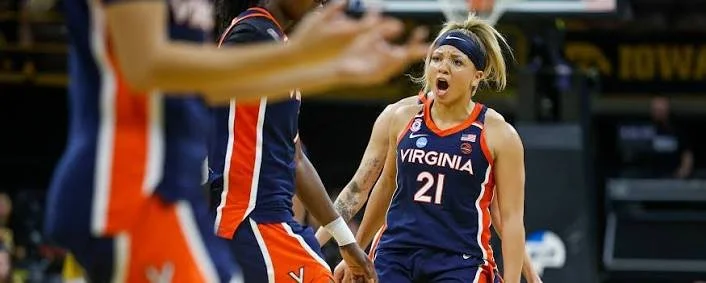
Photo: UVA Athletics
Breaking down Virginia's opening eight games
Nov. 2: Virginia 87, Maryland Eastern Shore 45
Virginia began the season with a 42-point victory, establishing an encouraging foundation on both ends of the floor.
Holding Maryland Eastern Shore to 45 points while scoring 87 demonstrated the type of balance the Cavaliers should pursue throughout the season.
Nov. 5: Virginia 72, Davidson 57
The Cavaliers secured their first road victory with a 15-point win over Davidson.
Winning away from home while limiting an opponent to fewer than 60 points provided an early indication of Virginia's ability to maintain its effectiveness outside Charlottesville.
Nov. 8: Virginia 99, William & Mary 58
Virginia recorded its highest scoring total through eight games, defeating William & Mary by 41 points.
The performance demonstrated the team's offensive ceiling when it can establish rhythm and create consistent scoring opportunities.
Nov. 11: Virginia 81, Drexel 39
Virginia's defense delivered its strongest scoring performance of the opening eight-game stretch, holding Drexel to 39 points.
The 42-point victory reinforced the Cavaliers' potential to establish control through defense rather than relying exclusively on offensive production.
Nov. 15: Virginia 80, Old Dominion 61
The Cavaliers improved to 5-0 with a 19-point road victory.
The result provided another encouraging example of Virginia's ability to travel successfully, an important characteristic for a team entering a demanding conference schedule.
Nov. 19: Virginia 60, James Madison 51
Virginia encountered its closest game of the season to that point against James Madison.
Although the Cavaliers scored only 60 points, they limited the Dukes to 51.
This victory was valuable because it demonstrated that Virginia could win without reaching the offensive production it displayed in previous games.
Nov. 23: No. 14 Oklahoma 86, Virginia 66
Virginia suffered its first defeat against nationally ranked Oklahoma at the Jacksonville Classic.
The Cavaliers nearly erased a 16-point third-quarter deficit, cutting Oklahoma's advantage to two points before the final quarter approached.
However, Oklahoma regained control and ultimately secured a 20-point victory.
Kymora Johnson and Mary-Anna Asare each scored 20 points, while Breona Hurd added 13.
The performance showed that Virginia has players capable of producing against nationally ranked competition. It also highlighted the importance of sustaining execution throughout all four quarters.
Nov. 24: Virginia 70, UAB 62
The Cavaliers responded to their first defeat by securing an eight-point victory over UAB.
Olivia McGhee led Virginia with a season-high 19 points and a career-high five 3-pointers.
Asare contributed 15 points, Johnson finished with 11 points, six rebounds and five assists, and Adeang Ring added 10 points and six rebounds.
Four Cavaliers scored in double figures, providing a meaningful example of Virginia's ability to distribute offensive responsibility.
The result improved Virginia to 7-1 and prevented its first loss from developing into a losing streak.
Kymora Johnson remains central to Virginia's success
Johnson's offensive versatility and playmaking ability make her one of the most important players in Virginia's lineup.
Against Oklahoma, Johnson recorded 20 points, eight assists and six rebounds.
The performance marked her fourth 20-point game of the season and moved her into sixth place on Virginia's career scoring list, passing Tammi Reiss with 1,853 career points.
Johnson's importance extends beyond individual scoring.
Her ability to create opportunities for teammates allows Virginia to operate with greater offensive flexibility.
Against UAB, Johnson contributed five assists and six rebounds despite scoring only 11 points.
That versatility becomes particularly valuable against opponents capable of limiting her scoring opportunities.
Virginia's highest ceiling will emerge when Johnson can remain an effective offensive creator without carrying an excessive share of the team's scoring responsibility.
The supporting cast is becoming increasingly important
Mary-Anna Asare
Asare demonstrated her scoring ability during the Jacksonville Classic.
She scored 20 points against Oklahoma, converting four of seven 3-point attempts.
Against UAB, she contributed 15 points, five rebounds and three assists.
Her ability to provide secondary scoring and perimeter production is important for an offense that opponents will frequently attempt to disrupt by concentrating on Johnson.
Olivia McGhee
McGhee's performance against UAB illustrated the impact reliable perimeter shooting can have on Virginia's offense.
She scored 19 points while converting seven of 12 field-goal attempts and five of nine 3-pointers.
If McGhee can provide consistent perimeter production, Virginia will have additional opportunities to create spacing and reduce pressure on its primary ball handlers.
Breona Hurd
Hurd recorded 13 points, six rebounds and three steals against Oklahoma.
Her ability to contribute across multiple statistical categories provides Virginia with valuable lineup flexibility.
Adeang Ring
Ring contributed 10 points and six rebounds against UAB while shooting five of seven from the field.
Efficient interior production will become increasingly important as Virginia encounters larger and more physical ACC frontcourts.
By the numbers: Virginia through eight games
Overall record: 7-1.
Home record: 4-0.
Road record: 2-0.
Neutral-site record: 1-1.
Total points scored: 625.
Total points allowed: 459.
Points per game: 78.1.
Points allowed per game: 57.4.
Average scoring margin: Plus-20.8.
Double-digit victories: Five.
Victories by at least 40 points: Three.
Opponents held below 60 points: Five.
Highest scoring performance: 99 points against William & Mary.
Fewest points allowed: 39 against Drexel.
Virginia's scoring margin demonstrates the effectiveness of its opening stretch, although the strength of the opposition must remain part of the evaluation.
The Cavaliers have established a strong foundation. Their next challenge is reproducing those advantages against more demanding competition.
What Virginia is doing well
Winning through different offensive approaches
Virginia has demonstrated the ability to score nearly 100 points while also winning a game in which it scored only 60.
That flexibility is encouraging because ACC competition will require the Cavaliers to adjust to different defensive approaches and game tempos.
Establishing a defensive foundation
Five of Virginia's first eight opponents scored fewer than 60 points.
The Cavaliers' ability to limit opponents provides an opportunity to remain competitive when their perimeter shots are not falling.
Developing multiple scoring options
Four players reached double figures against UAB.
Balanced scoring makes Virginia more difficult to defend and creates opportunities for Johnson to influence games as a facilitator.
Responding to adversity
Virginia's ability to win immediately following its loss to Oklahoma demonstrated an encouraging response to disappointment.
The Cavaliers will need that same resilience throughout conference play.
Areas Virginia must improve
Sustaining execution against ranked teams
The Oklahoma loss illustrated Virginia's ability to challenge a nationally ranked opponent for stretches.
However, narrowing a significant deficit and completing a comeback are different responsibilities.
Virginia must improve its ability to maintain offensive and defensive execution throughout an entire game.
Establishing reliable secondary scoring
Johnson is an established offensive leader, but Virginia cannot depend exclusively on her production against the strongest ACC defenses.
Asare, McGhee, Hurd and the rest of the rotation must provide consistent support.
Maintaining defensive discipline against explosive offenses
Allowing 86 points to Oklahoma represented a significant departure from Virginia's early defensive results.
Improved transition defense, communication and help positioning should remain priorities when facing opponents with multiple scoring threats.
Closing games with greater authority
Virginia's victories over James Madison and UAB demonstrated the ability to win closer games.
The next developmental step is consistently controlling the final possessions rather than allowing opponents opportunities to remain within striking distance.
Pretty Girls Media predictions: Virginia's next five games
Nov. 29 — at SMU, 6 p.m. ET
Virginia opens ACC competition on the road.
The Cavaliers' previous road victories offer encouragement, but conference opponents will present greater familiarity and more demanding adjustments.
Virginia should prioritize defensive discipline and balanced scoring.
PGM lean: Virginia victory.
Confidence: Moderate.
Dec. 3 — at Mississippi State, 9 p.m. ET
The SEC/ACC Challenge presents another opportunity for Virginia to test itself away from home.
The Cavaliers must demonstrate that they can sustain their offensive execution against physical competition.
This matchup could reveal whether Virginia has adequately addressed the weaknesses exposed by Oklahoma.
PGM lean: Slight edge to Mississippi State.
Confidence: Low.
Dec. 6 — vs. Boston College, 2 p.m. ET
Returning home provides Virginia with an opportunity to establish momentum in conference play.
Johnson's playmaking and the Cavaliers' defensive foundation should provide a competitive advantage if Virginia maintains consistent execution.
PGM lean: Virginia victory.
Confidence: Moderate.
Dec. 9 — vs. American, 6 p.m. ET
Virginia should have opportunities to establish its preferred offensive rhythm while continuing to develop its supporting cast.
Maintaining defensive intensity and avoiding unnecessary turnovers will be important.
PGM lean: Virginia victory.
Confidence: High.
Dec. 13 — vs. Navy, 6 p.m. ET
The Cavaliers should emphasize disciplined half-court execution, rebounding and efficient possession management.
This matchup provides another opportunity to build momentum before facing Kentucky later in December.
PGM lean: Virginia victory.
Confidence: Moderately high.
Projected outlook
Current record: 7-1.
Projected next five games: 4-1.
Projected record through Dec. 13: 11-2.
These projections represent editorial assessments rather than guaranteed outcomes.
A brief history of Virginia women's basketball
Virginia has an established women's basketball tradition, particularly through its success under longtime head coach Debbie Ryan.
The Cavaliers reached three consecutive Final Fours from 1990 through 1992, including an appearance in the 1991 national championship game.
Players such as Dawn Staley helped establish Virginia as an influential program in women's college basketball history.
The current Cavaliers have an opportunity to build their own identity while pursuing renewed postseason success.
The Pretty Girls Media assessment
Virginia's 7-1 record deserves recognition, but the Cavaliers should not be evaluated exclusively through their winning percentage.
The most encouraging development is their ability to produce through different players and win games with different scoring demands.
Johnson provides established championship-level individual ambition, while Asare, McGhee, Hurd and Ring offer complementary strengths.
Virginia is not yet a proven national championship contender.
However, the Cavaliers possess qualities that could make them a competitive ACC team and a potential NCAA Tournament threat.
The next several weeks will determine whether Virginia can move from promising early-season performances to sustained success against higher-level competition.
Sources: Virginia Athletics official schedule, Nov. 23 Oklahoma game recap, Nov. 24 UAB game recap and UAB Athletics official box score. Statistics reflect completed games through Nov. 24, 2026. Predictions and tactical assessments represent Pretty Girls Media editorial analysis.